
Breathing: the Ultimate Biohack

We are experiencing a seismic shift in how we approach wellness. Well-being is no longer a vague concept measured solely by an annual check-up, seasonal cleanse, and gym visits.
The standard for personal health is now focusing on evidence-based longevity and nervous system regulation. Rather than chasing quick fixes, the current movement blends traditional practices with clinical diagnostics to optimize healthspan and restore vitality.
From smart rings to analyzing full-panel biomarkers, high-performance wellness is more precise and data-rich than ever. Yet, among all the tracking and diagnostic suites, one physiological truth remains undeniable: If your body is trapped in chronic stress, even the most advanced tools and biohacks can fall short.
Your breath is the ultimate biohack, serving as your most accessible longevity tool to alter your biomarkers one breath at a time. The breath acts as an anchor—involuntarily responding to stress, while also giving you a voluntary lever to manually regulate your nervous system. When you intentionally alter your breath rhythm, you flip the feedback loop, signaling to your brain and nervous system to shift into a different mode.
Shifting from Hustle Culture to Balance
For years, wellness was dominated by a "more is better" mindset; high-intensity workouts, packed schedules, and pushing through fatigue. Today, the focus has shifted toward balance. Mindful movement, targeted stretching, sound baths, and breathwork are no longer fundamental tools used to combat tension, burnout, chronic pain, and sympathetic overdrive.
When you spend your days in a state of micro-stress, driven by endless notifications and hyper-productivity, your body remains in a sympathetic "fight-or-flight" state. This chronic state elevates baseline cortisol, disrupts sleep architecture, and accelerates cellular aging.
Conscious breathwork, focusing your awareness on and controlling your inhale, exhale, holds in set rhythms, acts as a direct intervention. Adjusting your respiratory rate by lengthening the exhalation while making an ocean sound you stimulate the vagus nerve. The vagus nerve signals to the brain that you are safe, triggering a parasympathetic recovery cascade that lowers blood pressure, drops heart rate, and restores internal equilibrium.
Optimizing Biomarkers from the Inside Out
The rise of functional health platforms and at-home panels has empowered people to track their internal health with clinical precision. We are monitoring markers like inflammatory proteins, fasting insulin, cortisol rhythms, and resting Heart Rate Variability (HRV).
If your goal is optimizing these longevity markers, breathwork is one of the most effective non-pharmacological levers available:
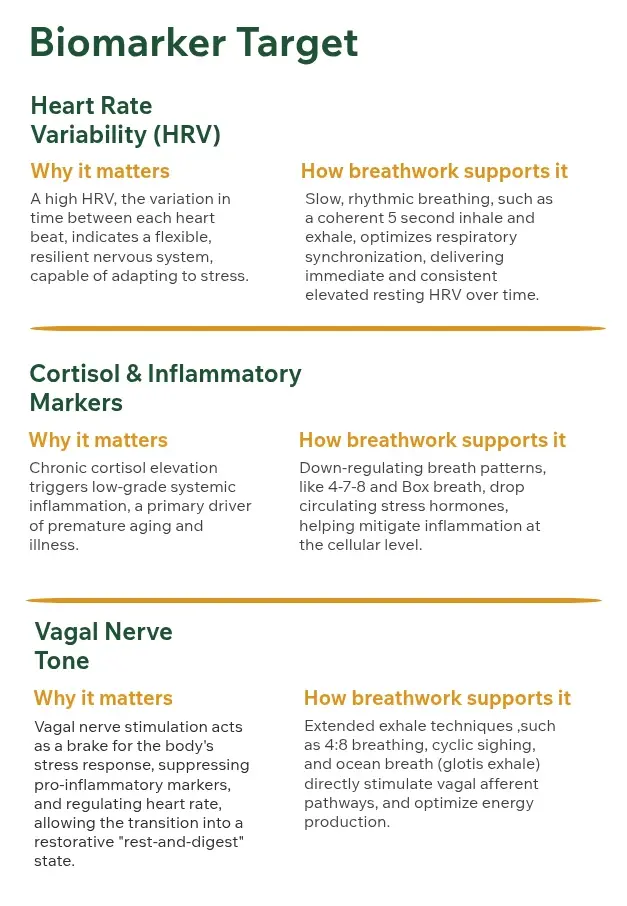
How Breathing Alters Your Physiology
Regulated breathing can create immediate, measurable shifts in your physical state. When you slow your respiratory rate to around five or six breaths per minute, you trigger respiratory sinus arrhythmia (RSA), a phenomenon where your heart rate naturally rises on the inhale and drops on the exhale.
Recent neuroscientific research published in Current Psychology demonstrates that conscious breath control directly alters cortical brain activity, shifting from high-beta stress frequencies down into calm alpha and theta waves. [1] A landmark 2023 study by Stanford Medicine researchers similarly found that brief daily sessions of cyclic breathwork emphasizing extended exhalations with a sigh outperformed traditional mindfulness meditation in reducing physiological anxiety, lowering baseline respiratory rate, and improving daily mood. [2]
By systematically altering your breathing patterns, you stimulate the vagus nerve and alter brainwave dynamics. This neurological shift signals to every cell in your body that it is safe to shift out of survival mode and into repair, recovery, and long-term cellular maintenance.
Anchor Your Longevity Strategy Today
Build a regular practice by matching the right breath pattern to your specific needs. Whether you are seeking daily balance, better sleep, sharper focus and clarity, or mind harmony, intentional how you breath allows you to target your state in real time.
Visit the RSbreathe.com interactive Breath Timer Library to access 6 guided timers with visual and audio prompts, featuring techniques like Alternate Nose (Nadi), 4-7-8, Box Breathing, Coherent, and more. Learn how to pair each technique with your longevity goals in our article Interactive Breathing Timers for Daily Nervous System Regulation.
Ready to take your biohacking to the next level join an upcoming guided Classes in Philadelphia or New Jersey, or Book a private one-on-one session to discover the transformative power of your breath.
The information and research findings presented in this article are for educational purposes only and are not a substitute for professional medical or psychological care. Please consult your physician or a qualified healthcare provider before beginning a new breathwork practice, if you have pre-existing medical or mental health conditions.
1 Bahi, C., Irrmischer, M., Franken, K. et al. Effects of conscious connected breathing on cortical brain activity, mood and state of consciousness in healthy adults. Curr Psychol 43, 10578–10589 (2024). https://doi.org/10.1007/s12144-023-05119-6
2 Balban M, Neri E, Kogon M…Brief structured respiration practices enhance mood and reduce physiological arousal. Cell Reports Medicine, 2023; 4


Comments