
6 Ways to Regulate Your Nervous System (Plus Free Breath Timers)

Updated: 23 hours ago

We carry our breath with us everywhere; its pattern alters, tuned to our nervous system in response to the world around us. It can go from full and steady to shallow and fast when a stressful situation arises. We shift into the sympathetic nervous system (SNS) “fight or flight” mode, instantly alerting our body to prepare for survival.
The good news is that the communication runs both ways. Just as external situations use your nervous system to change your breath, you can consciously use your breath to speak directly to your nervous system. By using down-regulating breath styles, we can choose to switch to the parasympathetic nervous system (PNS), which promotes relaxation, digestion, and reduced heart rate, signaling safety, balance, and calm.
To make daily breath practice easy, use the Interactive Breath Timers on RS Breathe.
Core Benefits, Including Stress Relief
Incorporating daily regulated breathing and mindfulness practices into your routine supports both a more immediate relief response and long-term somatic wellness:
Stress Relief
It can shift your nervous system in under 3 minutes.
Sharper Mental Focus
Creates presence by anchoring your awareness in the present moment.
Better Sleep Quality
Prepares the mind and body for deeper, more restorative sleep.
Emotional Grounding
Creates space between a stress trigger and your reaction.
The Science: What Is Happening Inside Your Body?
Breathing to down-regulate the nervous system state generally consists of rhythmic breathing, sometimes where the exhale is longer than the inhale or you hold your breath between inhalations.
As you inhale, the diaphragm contracts, expanding your belly and chest. As you exhale, it relaxes, allowing them to gently fall. The movement stimulates your vagus nerve, the superhighway of your PNS “rest and digest” system. In response, it sends signals that naturally slow your heart rate down, settle your blood pressure, and reduce stress hormone production. By extending your exhalation or adding brief, comfortable breath holds, you send a clear physical cue back to your brain that you are safe, grounded, and that you can relax.
Scientific research supports what ancient traditions have practiced for centuries:
Lowering Physiological Stress:
A 2023 study led by researchers at Stanford University (Cell Reports Medicine) found that spending just a few minutes a day doing structured, slow breathwork produced greater reductions in anxiety and daily negative affect than passive mindfulness meditation.
Building Heart Coherence:
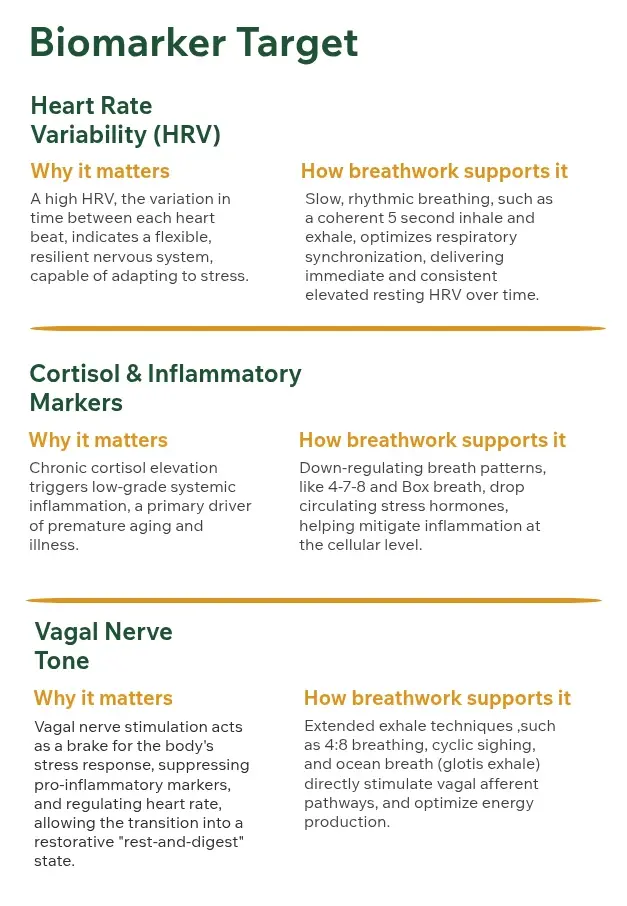
Research published in Psychosomatic Medicine highlights that breathing at a rate of approximately 5 to 6 breaths per minute maximizes Heart Rate Variability (HRV). High HRV is a key indicator of cardiovascular resilience, emotional balance, and stress adaptation.
Autonomic Balance:
Clinical studies evaluating Alternate Nostril Breathing (Nadi Shodhana) show that alternating airflow between nostrils balances sympathetic and parasympathetic inputs, improving attention scores and calming the autonomic nervous system.
How to Practice Regulating Your Nervous System
Most of the following techniques include a 5-second inhale and exhale to balance your breathing rhythm to six breaths per minute, which is the physiological frequency where your heart, lungs, and brain enter a state of biological synchronization. A balancing breath shifts your brain to alpha waves, a state of alert calmness, the zone of focus, learning, and entering the flow.
Initially, a full 5 seconds may not feel comfortable. You can adjust the time based on your current level of comfort and gradually increase the duration as your breath capacity and heart rate variability improve.
Everyone’s nervous system is unique, and different moments call for different breathing patterns, varying the duration and using breath holds. Here are six nervous system regulating techniques available on the RS Breathe Breath Timers Page:
1. Coherent 5-Second Breath (balancing breath)
The Pattern: 5-second Inhale, 5-second Exhale.
How To Do It: Inhale through your nose for 5-seconds, then allow a smooth, unforced 5-second exhale. Repeat.
Best For: Overall nervous system balance and heart coherence.
2. 4:8 Extended Exhale Breath
The Pattern: 4-second Inhale, 8-second Exhale (a 1:2 ratio).
How To Do It: Inhale through your nose for 4 seconds, then double the duration of your gentle exhale to 8 seconds.
Best For: Rapid down-regulation, releasing physical tension, and soothing an overactive mind. Doubling your exhale maximizes vagal nerve engagement, slowing your heart rate and sending an immediate signal of safety to your brain.
3. 4-7-8 Relaxing Breath
The Pattern: 4s Inhale, 7s Hold, 8s Exhale.
How To Do It: Inhale through your nose for 4 seconds, gently hold your breath for 7 seconds, and release a slow, unforced exhale for 8 seconds.
Best For: Deep relaxation, calming acute anxiety, and transitioning into restful sleep. The combination of a prolonged hold and an extended 8-second exhale acts as a natural tranquilizer for your nervous system.
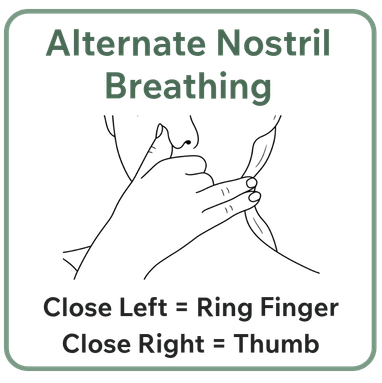
4. Alternate Nostril Breathing (Nadi Shodhana)
The Pattern: Rhythmic single-nostril inhale/exhale cycles.
How To Do It: Tuck the index and middle fingers of your right hand into your palm. Use your thumb to close your right nostril and inhale through the left. Close the left nostril with your ring finger, and exhale through the right. Repeat by alternating between left and right nostril.
Best For: Brain balance, mental clarity, and anxiety relief.

5. Box Breathing (Square Breathing)
The Pattern: 4s Inhale, 4s Hold, 4s Exhale, 4s Hold.
How To Do It: Equal counts across all four phases create a stabilizing "box" structure that halts panic and grounds your focus. Picture drawing a square in your mind, where each equal side represents one 4-second action.
Best For: High-stress moments and building resilience under pressure.

6. Triangle Breathing
The Pattern: 4 seconds (4s) each, including holding your breath: 4s Inhale, 4s Hold, 4s Exhale.
How To Do It: Ideal if breath-retention in box breathing feels too intense; it offers a gentle pause to anchor your focus without strain. Picture drawing a triangle in your mind, where each equal side represents one 4-second action.
Best For: Steadying focus and gentle energy reset.
Start Your Breathing Practice Today
Regulated breathwork adapts seamlessly to your day. For a quick reset, try 5 minutes (30 breath cycles) to calm an overactive nervous system and find balance. Try it before bed for a better night’s rest. Discover lasting benefits by creating a daily extended practice of 10 to 20 minutes (60 to 120 cycles). Ideal for deep autonomic regulation, improving sleep quality, and strengthening long-term stress resilience.
Listen to what your body needs in the moment. To make it easy, explore the RS Breathe Interactive Breath Timers. Choose your rhythm, adjust the breath duration to your comfort level, and let the visual rhythm guide you back to balance.
Ready to build or deepen your breath and mindfulness practice? Explore RS Breathe Classes to find upcoming group events in Philadelphia and New Jersey, or Book a private one-on-one session personalized to support your nervous system.


Comments