
Conscious Connected Breathing: Ignite Your Body's Intelligence

Updated: 23 hours ago

Your breath is a quiet mirror reflecting how you feel, yet we rarely pay attention to what the reflection tells us. Have you noticed what happens when stress, anxiety, trauma, or racing thoughts take over? Your breath quietly shifts upward into your chest, becoming shallow and strained.
When this guarded breathing pattern becomes stored in your body memory, it starts influencing how you breathe every day. As you default to this contracted, shallow rhythm, it continuously signals to your nervous system that you are in a heightened state of stress or threat, even when you are actively trying to relax.
If you’ve ever felt like you know you should relax but can’t, or that traditional talk therapy only gets you halfway there, you aren't imagining it. It is extremely difficult to simply think your way out of a physical response pattern. Stress and trauma don't just live in your thoughts; they lock themselves into the body and continuously communicate with your nervous system.
This is where Conscious Connected Breathing (CCB) comes in. CCB is an active, energizing practice that bridges your conscious mind, subconscious, and body’s innate intelligence to create release at a much deeper level.
What Is Conscious Connected Breathing?
There are many conscious connected breathing techniques, such as Rebirthing, Holotropic, Shamanic, and Transformational Breathwork®. At its heart, conscious connected breathing relies on a simple, continuous rhythm: engaging your diaphragm to move fluidly from inhale to exhale without stopping, creating a seamless loop.
The four main components include:
1. Conscious Presence: You stay gently anchored in the physical feeling of the breath moving through your body, keeping your awareness present and non-judgmental throughout the continuous cycle.
2. Engaging the Diaphragm: You take a full, active inhalation deep into your belly, letting it expand smoothly up into your chest.
3. Relaxed Exhale: Instead of forcing or blowing the air out, you simply let the breath fall away like a soft sigh, allowing gravity and natural muscular recoil to do the work.
4. Connected Flow (no pauses): The moment your inhale reaches its top, it rolls straight into the exhale—and the moment the exhale completes, you transition seamlessly back into the next inhale without holding your breath.
How Can CCB Help You?
Conscious connected breathing works from the inside out to create changes you can genuinely feel. By bypassing the analytical mind, it allows your body to safely discharge old tension, grief, anger, or anxiety held deep in your physical system.
Breaking this pattern quiets the inner critic, providing direct access to deep emotional clarity, intuition, and self-compassion. It gently expands your capacity to handle intensity, teaching your body that it can experience strong sensations and emotions while remaining safe and grounded.
By breathing fully without pauses, you flood your system with vitality, leaving you feeling lighter, clearer, and deeply reconnected to your true self. As the strain on your breathing pattern releases, you begin building lasting nervous system resilience.
The Science: Why Your Body Responds So Deeply
When you eliminate the pause between your inhale and exhale, you remove your body's primary mechanism for holding back. Normally, when uncomfortable emotions or stress arise, our automatic reflex is to freeze, brace, or hold our breath. Circular breathing breaks that defense pattern.
Clinical research helps better explain why this style of deep continuous breathing affects the physical body and emotions so intensely. Using science to better explain what is happening beneath the surface to:
Improve Well-Being
Electroencephalography (EEG) has measured shifts in specific brainwave activity, demonstrating that deep, continuous breathwork (CCB) reduces overactivity in brain centers tied to constant worrying, overthinking, and self-judgment. This shift opens up mental space for emotional breakthroughs and clarity. Additionally, participants' scores on the Profile of Mood States (POMS) questionnaire showed significant decreases in anger, tension, confusion, and depression, alongside reports of emotional release and mystical experiences. [1]
Relieve Anxiety
In a randomized controlled test, connected breathwork participants experienced drops in anxiety scores nearly 9 points higher than the control group, proving CCB to be an accessible, effective tool for mental well-being. [2]
Balance Hormones & Immunity Function
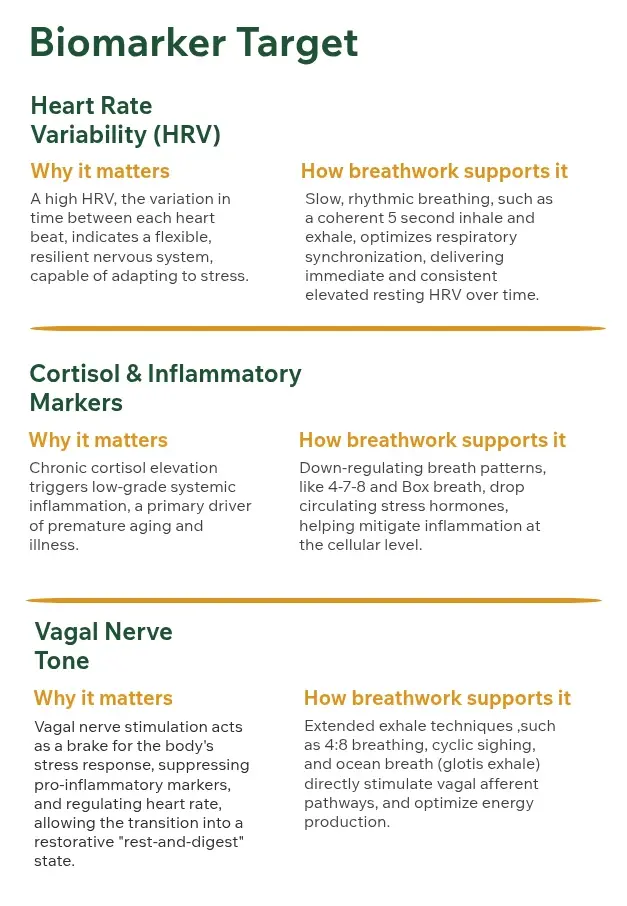
Studies show that connected breathing can significantly lower cortisol (your primary stress hormone) while boosting prolactin (a key immune-supporting hormone), helping shift your body out of chronic fight-or-flight and into physical recovery. [3]
Reclaim Your Body's Innate Wisdom
Your breath has been with you through every single moment of your life, quietly recording every memory, stored tension, and emotional story you’ve experienced along the way. But you don't have to carry those old, guarded patterns forever.
Through conscious connected breathing you remember how to trust your body's innate wisdom. You step out of the analytical mind and into a continuous flow, providing your body and emotional system the support, safety, and space it needs to release what no longer serves you.
Welcome to RSbreathe.com
Whether you are brand new to breathwork or looking to deepen an established practice, you are in the right place. Explore our articles, discover scientific resources, and join an upcoming guided Classes in Philadelphia or New Jersey, or Book a private one-on-one session to discover the transformative power of your breath.
The information and research findings presented in this article are for educational purposes only and are not a substitute for professional medical or psychological care. Please consult your physician or a qualified healthcare provider before beginning a new breathwork practice, if you have pre-existing medical or mental health conditions.
References & Footnotes
[1] Bahi, C., Irrmischer, M., Franken, K. et al. Effects of Conscious Connected Breathing on Cortical Brain Activity, Mood, and State of Consciousness in Healthy Adults. Current Psychology 43, 10578–10589 (2024). https://doi.org/10.1007/s12144-023-05119-6
[2] Blake, R. L. Efficacy of online conscious connected breathwork in reducing symptoms of anxiety: A randomized waitlist control trial. J Affect Disord. 2026 Feb 1;394(Pt A):120565. doi: 10.1016/j.jad.2025.120565. Epub 2025 Oct 29. PubMed PMID: 41167435. https://pubmed.ncbi.nlm.nih.gov/41167435/
[3] Heyda, A., Gdowicz-Kłosok A., et al. Take a Breather: Physiological Correlates of a Conscious Connected Breathing Session in a Trained Group of Breast Cancer Patients. Cancers (Basel). 2025 Nov 18; 17(22), 3690. https://pmc.ncbi.nlm.nih.gov/articles/PMC12651910/ [cite: 1, 8]


Comments